 Paraguay
Avoid Toll Surprises in Paraguay: 3 Route Costs & Payment Tips

Tolls are mandatory on every major national route in Paraguay, from PY01 to PY02 to the Ecovía, and skipping a plaza carries fines. Two kinds of operators run them: the state’s MOPC and private concessionaires like Tape Porã S.A. and Rutas del Este. A light vehicle, Category 1, typically pays the standard rate charged by MOPC plazas or higher rates charged at some concession stations.
TL;DR:
- Tolls on Paraguay’s major highways, including PY01, PY02, and the Ecovía, are operated by both the state and private concessionaires, with rates varying by vehicle category and operator.
- Cash in Guaraní remains the most reliable payment method, but many plazas now accept cards, QR codes, and RFID tags, though cross-operator RFID interoperability is limited.
- Toll rates are set through official resolutions and can change with short notice, with some state plazas suspending charges during certain holidays, unlike private concessions.
- Small vehicles (Category 1) typically pay between 19,000 and 20,000 G. at most plazas, with routes like Asunción to Ciudad del Este costing around 68,000 G., depending on the operator and route.
- Repeated toll evasion results in fines and can complicate vehicle registration, making it essential to pay or resolve any issues at the plaza immediately with receipts and proper documentation.
Table of Contents
- Where Toll Plazas Sit on Paraguay’s Highway Map
- What You’ll Actually Pay by Vehicle Category and Operator
- Cash, Card, QR, or RFID: How Paying Actually Works
- Why One RFID Tag Won’t Get You Everywhere
- Rate Changes, Resolutions, and Holiday Toll Suspensions
- Budgeting a Trip: Three Routes Worked Out
- A Short Checklist Before You Hit the Highway
- Why Paraguay Built a Toll System in the First Place
- How Tolls Shape Traffic Patterns and Local Economies
- What Happens if You Try to Skip a Toll
- Getting Help When a Charge Looks Wrong
- Where Paraguay’s Toll Network Goes From Here
- What Years of Toll Confusion Actually Teach You
- Let Someone Else Handle the Toll Booths
- Sources
Where Toll Plazas Sit on Paraguay’s Highway Map
Paraguay’s toll network follows its busiest corridors: PY01 toward Encarnación, PY02 toward Ciudad del Este, PY03 toward Concepción, the PY05 through PY10 network, and the Ecovía loop around Asunción. Who collects your money at each plaza depends entirely on who built or maintains that stretch of road.
MOPC runs the state-operated plazas directly, funding road maintenance and safety programs from the proceeds. Private concessionaires took over specific corridors under long-term contracts, and they set their own rates within limits MOPC approves.
On PY02 alone, Tape Porã S.A. operates the Pastoreo (Juan Manuel Frutos), Minga Guazú, Ypacaraí, and Nueva Londres plazas. Rutas del Este holds a separate concession further along the eastern routes. The clearest way to see exactly which plaza sits where, and who runs it, is the official MOPC toll plaza map, which lists every station by route and operator.
- PY01 (Asunción to Encarnación): primarily MOPC-managed
- PY02 (Asunción to Ciudad del Este): Tape Porã concession plazas at Pastoreo, Minga Guazú, Ypacaraí, and Nueva Londres
- PY03 (Asunción to Concepción): MOPC-managed
- Ecovía (Asunción metro loop): MOPC-managed, slightly higher standard rate
- PY05 through PY10: mixed state and concession depending on segment
What You’ll Actually Pay by Vehicle Category and Operator
Every plaza in Paraguay sorts vehicles into categories, and the numbers can shift depending on which of the eight classes your vehicle falls into. Vehicle categories range from light vehicles such as standard cars and SUVs in Category 1, to heavier trucks and buses in higher categories, with the largest multi-axle cargo vehicles in Category 8.
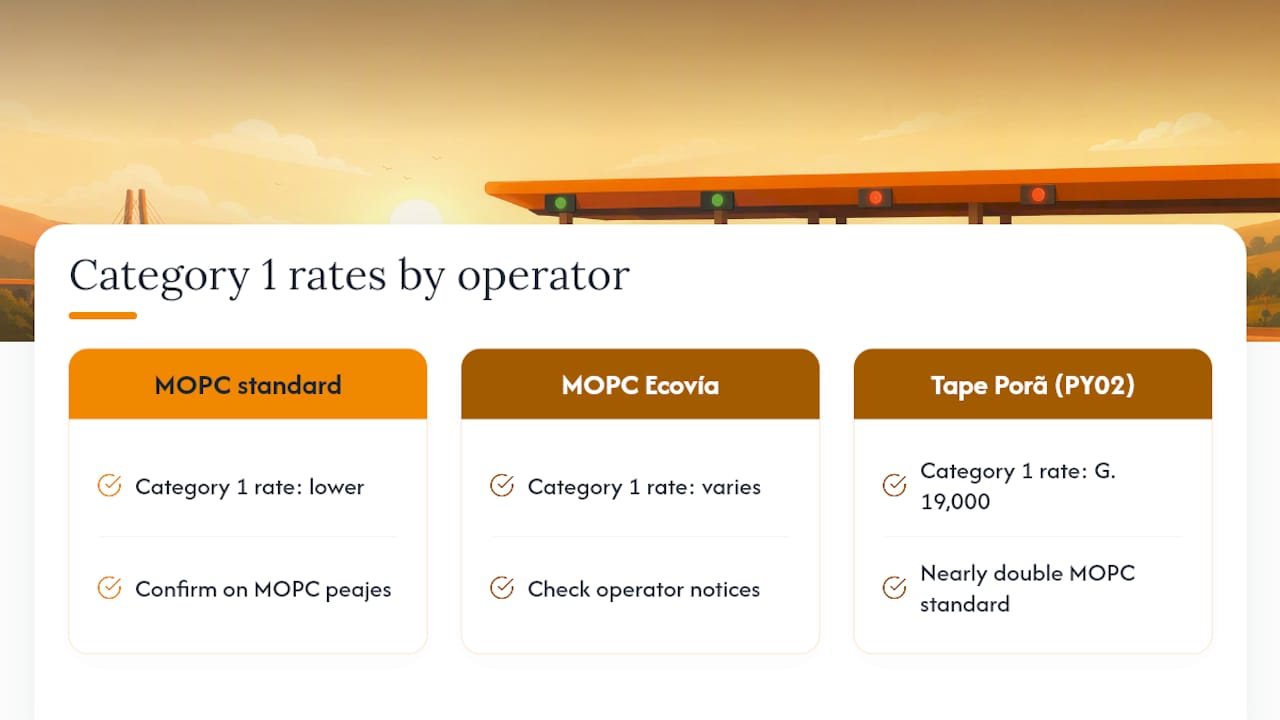
For a typical traveler in a car, Category 1 is what matters most to travelers, with rates varying between MOPC standard plazas, MOPC Ecovía, and concession operators like Tape Porã (PY02). Rates vary by segment and operator, so it is advisable to check current operator notices before any long trip. MOPC’s own resolution set the Tape Porã Category 1 rate at G. 19,000, nearly double the standard MOPC figure, reflecting the higher maintenance costs and traffic volume on that corridor. Every rate change traces back to a formal resolution, so the MOPC peajes page is the fastest way to confirm you’re budgeting with current numbers, not last year’s.
Cash, Card, QR, or RFID: How Paying Actually Works
Every plaza in Paraguay accepts cash in Guaraní, and that’s still the fallback that never fails you. Carrying smaller bills matters more than it sounds. Toll booth staff run through hundreds of cars a day, and handing over a large note for a G. 10,000 fee can slow the line while they scrounge for change.
Beyond cash, most MOPC plazas have rolled out POS terminals and QR code payment, letting you tap a card or scan with a banking app instead of digging for bills. Concession plazas, including Tape Porã stations, have gone further, layering in Telepeaje RFID lanes that let a tagged vehicle roll through without stopping at all.
- Cash in Guaraní: universally accepted, keep small denominations
- POS card payment: available at most MOPC plazas and many concession stations
- QR code payment: increasingly common at MOPC plazas
- Telepeaje/RFID: available on select concession routes, requires a pre-registered tag
Pro Tip: Never assume a plaza takes cards. Keep at least G. 40,000 to G. 50,000 in small bills in the car for a multi-plaza trip, even if you plan to pay electronically everywhere else.
Why One RFID Tag Won’t Get You Everywhere
Paraguay doesn’t have a single unified electronic toll tag that works across every operator’s network. Tape Porã’s RFID lanes on PY02 read tags tied to its own Sistema Integrado de Control de Peaje, and that system doesn’t necessarily talk to MOPC’s own plazas or to Rutas del Este’s infrastructure on a different corridor.
That gap catches out travelers who assume one account covers a whole intercity trip.
- A Tape Porã tag works reliably at Tape Porã lanes, not guaranteed elsewhere
- MOPC plazas rely mainly on cash, POS, and QR rather than a shared RFID standard
- Long routes crossing multiple concessions may require separate arrangements per operator
If your trip crosses from a state-run stretch into a concession corridor, verify tag acceptance before you count on it. Cash or card as a backup avoids an awkward stop at the gate.
Rate Changes, Resolutions, and Holiday Toll Suspensions
Toll rates in Paraguay move when MOPC issues a formal resolution, not on a whim. The most recent update to hit PY02 traced directly to Resolución N.° 2519/2024, which set the current Tape Porã Category 1 rate. Concessionaires publish their own notices once a resolution takes effect, so the timing between government approval and the price change at the booth is usually short.
Holidays complicate things further. On certain presidential-decreed holidays, some MOPC-run plazas have waived collection entirely, letting traffic pass free as a goodwill gesture during peak travel periods. Concession plazas generally don’t follow suit. Tape Porã and similar operators tend to keep charging their published rate regardless of the calendar.
- Rate changes originate from MOPC resolutions, published on the official site
- Concessionaires issue their own confirmation notices once a new rate is approved
- Some state plazas suspend charges on select holidays; concession plazas usually don’t
- Check MOPC and the relevant operator’s notices before any holiday road trip
Budgeting a Trip: Three Routes Worked Out
Estimating total toll cost for a route is mostly arithmetic once you know which plazas sit along the way and what each charges a Category 1 vehicle.
- Asunción to Ciudad del Este (PY02): Passing through the Tape Porã plazas at Pastoreo, Minga Guazú, and additional stations along the route, a Category 1 vehicle’s toll total lands around ₲68,000, a figure that TollGuru’s route calculator confirms across the full plaza sequence.
- Asunción to Encarnación (PY01): Running mostly through MOPC-managed plazas at roughly G. 10,000 each, two or three stations on this corridor put a light vehicle’s total in the G. 20,000 to G. 30,000 range.
- Luque to San Bernardino: A shorter regional hop, typically crossing just one or two Ecovía or MOPC plazas, keeping the total under G. 30,000 for most cars.
The formula scales simply: add each plaza’s Category 1 rate for your route, then multiply by a higher factor for larger vehicles like pickups or vans, since higher categories pay more per plaza.
A Short Checklist Before You Hit the Highway
Running through Paraguay’s toll corridors goes smoother with a few basics handled before you leave.
- Carry Guaraní cash in small bills, plus a working card and a QR-capable banking app
- Don’t rely on a single Telepeaje tag for a route that crosses multiple operators
- Keep your receipt if a charge looks wrong, and raise it with the operator’s customer line at the plaza
- Factor toll costs into your total trip budget before departure, not after
Hiring a private driver removes most of this planning. A long distance car service that already knows every plaza on your route handles payment without you touching a wallet at the booth.
Pro Tip: If a plaza charges you the wrong category, ask for a receipt on the spot. Disputing a charge later without documentation rarely goes anywhere.
Why Paraguay Built a Toll System in the First Place
Paraguay’s toll network didn’t emerge from a single policy overnight. It grew out of a practical problem: national highways connecting Asunción to Ciudad del Este, Encarnación, and Concepción needed continuous maintenance, and general tax revenue alone wasn’t reliably funding that upkeep.
MOPC frames toll collection as an investment in road safety and national development, funneling revenue into pavement repair, signage, and roadside assistance posts along the busiest corridors. The logic mirrors what dozens of countries have done with heavily trafficked highways: users of the road pay directly for the road’s condition rather than spreading that cost across every taxpayer, including those who never drive the route.
The concession model added a second layer. Rather than fund every major corridor through the state budget alone, Paraguay handed specific stretches, PY02 among them, to private operators under long-term contracts. Tape Porã and Rutas del Este took on construction and maintenance obligations in exchange for the right to collect tolls at set rates approved by MOPC.
That split explains why rates differ so much between a state plaza and a concession plaza. A private operator financing a highway upgrade needs revenue that covers its investment, while MOPC’s own plazas operate closer to a maintenance cost recovery model. Neither approach is inherently wrong, they’re just solving different funding problems on different roads.
How Tolls Shape Traffic Patterns and Local Economies
Toll fees change driver behavior in predictable ways. Some local drivers on short daily commutes near a plaza choose alternate roads to avoid repeated charges, shifting traffic onto secondary routes that weren’t designed for that volume. That pattern shows up around several MOPC and concession plazas near urban centers, where side roads see more local traffic during peak hours specifically to dodge the toll.
For longer intercity trips, the calculation flips. Drivers heading from Asunción to Ciudad del Este or Encarnación rarely have a practical alternate route, so the toll simply becomes a fixed cost of the trip, similar to fuel.
The economic side cuts both ways. Toll revenue funds the maintenance that keeps PY02 and PY01 passable for the trucking traffic that carries much of Paraguay’s agricultural exports toward Brazilian and Argentine border crossings. Without that funding stream, road degradation on high-traffic corridors would likely accelerate faster than general infrastructure budgets could keep pace with repairs.
At the same time, businesses along toll corridors, gas stations, roadside restaurants, small hotels, benefit from the traffic that tolled highways concentrate onto a predictable route. A well-maintained highway with consistent toll-funded upkeep tends to support more reliable commercial traffic than a degraded free alternative would. The net effect for most travelers is straightforward: a few thousand Guaraní at each plaza buys a road surface that doesn’t destroy your suspension.
What Happens if You Try to Skip a Toll
Driving through a Paraguay toll plaza without paying isn’t a gray area. Every plaza, whether MOPC or concession, treats a deliberate pass without payment as toll evasion, and the standard response involves a fine that the operator or MOPC can enforce through vehicle registration records.
Concession operators like Tape Porã run camera systems at their plazas specifically to catch vehicles that pass through an open lane without stopping, whether by driving too fast for staff to flag them down or exploiting a raised barrier during a system glitch. Once your license plate is logged as having skipped payment, the outstanding toll fee typically gets added to future transactions or pursued as a separate collections matter.
Repeated evasion carries steeper consequences than a single missed payment. A pattern of unpaid tolls on your vehicle’s record can complicate registration renewals or other administrative transactions tied to your plate, since toll debt increasingly gets cross-referenced with other vehicle records in Paraguay’s administrative systems.
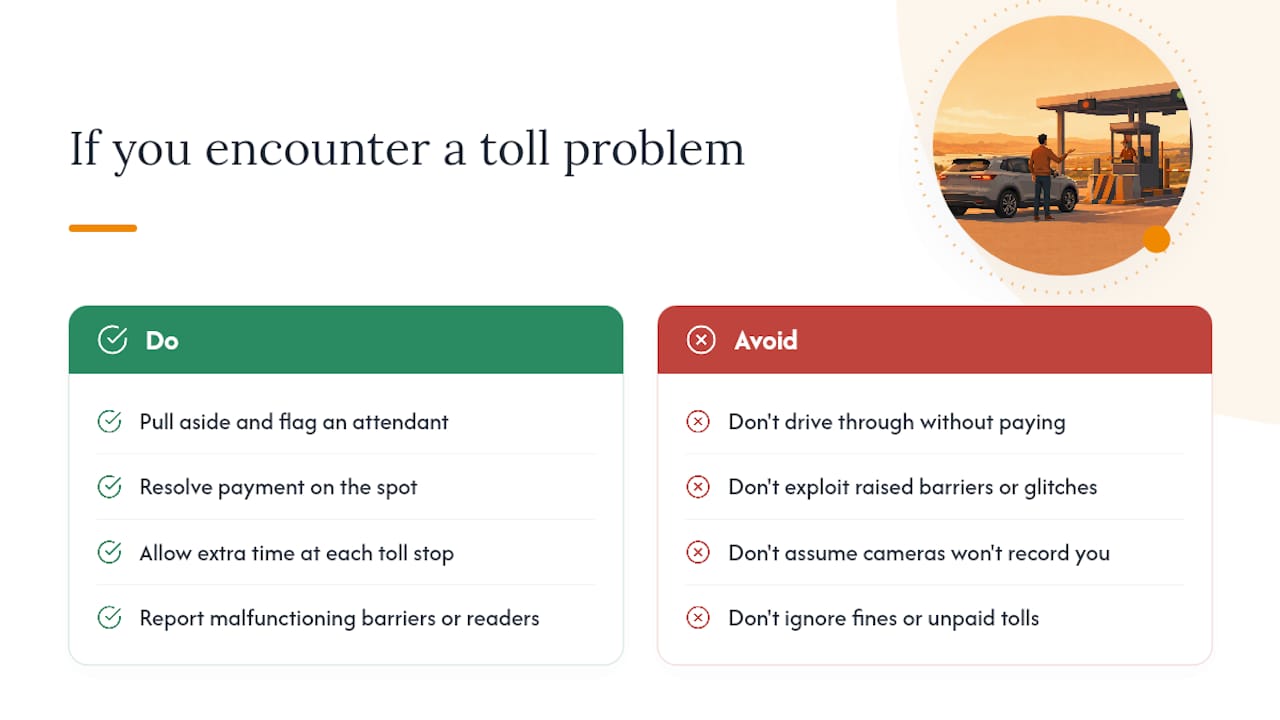
The practical lesson here is simple: if a plaza malfunctions, a barrier doesn’t lift, a card reader fails, don’t just drive through. Pull aside, flag an attendant, and resolve the payment on the spot. That five-minute delay costs far less than a fine notice arriving weeks later, and it avoids any ambiguity about whether you intended to pay.
For travelers unfamiliar with Paraguay’s plaza layouts, this is one more argument for building in extra time at each toll stop rather than rushing through in unfamiliar territory.
Getting Help When a Charge Looks Wrong
Every toll operator in Paraguay, MOPC included, maintains a channel for travelers to flag an incorrect charge or a malfunctioning plaza. The first step is always the same regardless of operator: get a receipt at the moment of payment. Without one, disputing a charge afterward turns into a word-for-word argument with little supporting evidence on either side.
MOPC handles complaints about its own state-run plazas through its general public channels, and its peajes information page lists current contact points for reporting issues at specific stations. Concessionaires operate their own separate customer service lines. Tape Porã, for instance, publishes contact details through its SICP platform for drivers who need to report a billing discrepancy or a technical fault with an RFID lane.
Common complaint scenarios include being charged the wrong vehicle category, a card reader double charging a transaction, or an RFID tag failing to register at a lane despite an active account. In each case, documenting the date, time, plaza location, and payment method at the moment of the incident makes resolution considerably faster than trying to reconstruct details later from memory.
If you’re driving a rental or a vehicle registered outside Paraguay, keep extra documentation. Category disputes tend to happen more often with vehicles that don’t fit the standard local classification, and having your registration or rental agreement on hand at the plaza avoids an argument at the barrier.
Where Paraguay’s Toll Network Goes From Here
Paraguay’s road infrastructure is still expanding, and toll plazas tend to follow new highway construction rather than precede it. As MOPC and private concessionaires extend paved corridors into currently underserved regions, particularly connections branching off the core PY01 through PY03 network, new toll points are a near certainty on any newly upgraded stretch that carries significant freight or passenger volume.
The bigger structural question is whether Paraguay eventually consolidates its patchwork of operator-specific electronic tolling into something closer to a unified system. Right now, each concessionaire runs its own RFID infrastructure, and that fragmentation creates friction for any driver crossing between concession zones on a single trip. Countries facing similar growing pains have typically moved toward interoperable tag standards once enough operators are running electronic lanes to justify the cost of unifying them. Paraguay hasn’t announced a firm timeline for that kind of integration, but the pattern elsewhere suggests it’s the direction infrastructure planning eventually heads.
For now, the practical reality for travelers is that the network will keep growing route by route, rate by rate, with each new concession or MOPC extension bringing its own tariff structure. Anyone planning regular travel across multiple corridors should expect to keep checking official notices rather than assuming today’s rates and plaza list will look the same in a year or two.
What Years of Toll Confusion Actually Teach You
Every plaza in Paraguay runs its own rhythm. Some MOPC stations wave you through in seconds with a QR scan, while a Tape Porã lane at rush hour can back up for a quarter mile if the RFID reader hiccups. That inconsistency, more than the fees themselves, is what wears down a long drive.
It’s also exactly why travelers doing intercity runs, especially to Ciudad del Este or Encarnación, increasingly hand the logistics to someone who already knows which lane moves and which one doesn’t.
— David
Let Someone Else Handle the Toll Booths
Paraguaytransport is the practical alternative to renting a car and figuring out Paraguay’s toll patchwork on your own. Fares include toll costs along the route, removing the need to handle toll payments at the booth or worry about payment methods at different plazas.

Drivers provide multilingual service, track flights for timely pickups, and offer door-to-door transport without transfers. Whether it’s an Asunción to Ciudad del Este run through the Tape Porã corridor or a cross-border trip into Brazil, the toll math and route planning are already handled before you get in the car. Payment is accepted through various convenient methods including cash, cards, and digital payments. Get an instant quote over WhatsApp and book your next transfer through Paraguaytransport before your trip.
Sources
- Mapa de puestos de peaje en Paraguay – MOPC
- Paraguay Toll Roads Complete Guide: Peaje, Rates & Payment 2026 – TollGuru
Recommended
Need a ride in Paraguay?
Fixed-price transfers, airport pickups and day trips — quoted upfront on WhatsApp.